The way
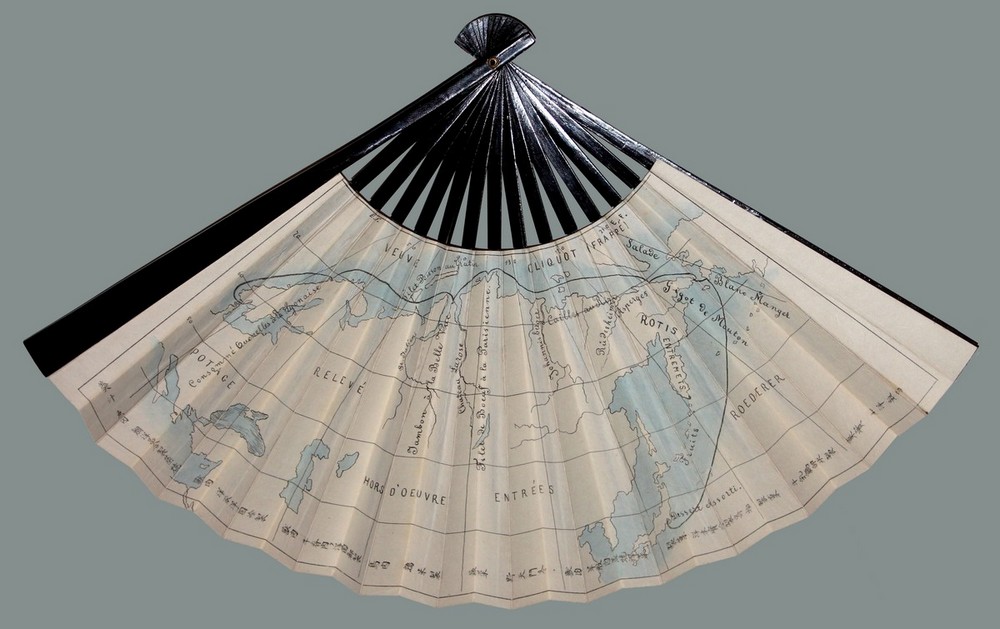
we show the reverse below may surprise, as the fan is seen upside down!
But this is the right way to look at. Indeed, the designer has very
cleverly taken advantage of the relationship between our favorite
object and a part of a globe to imagine the North Pole as the axis of the fan. So he has placed the Arctic Ocean near the gorge, allowing to include
the progress of the expedition of Professor Nordenskiöld, Captain
Palander and the crew of the Vega. The leaf wears also lines giving the indications
of longitude (5, 9, 13, 18, 21°) and the parallels of latitude (50, 60,
70 -? -°) as well.
So we follow fairly well the ship's voyage from Sweden to Japan.
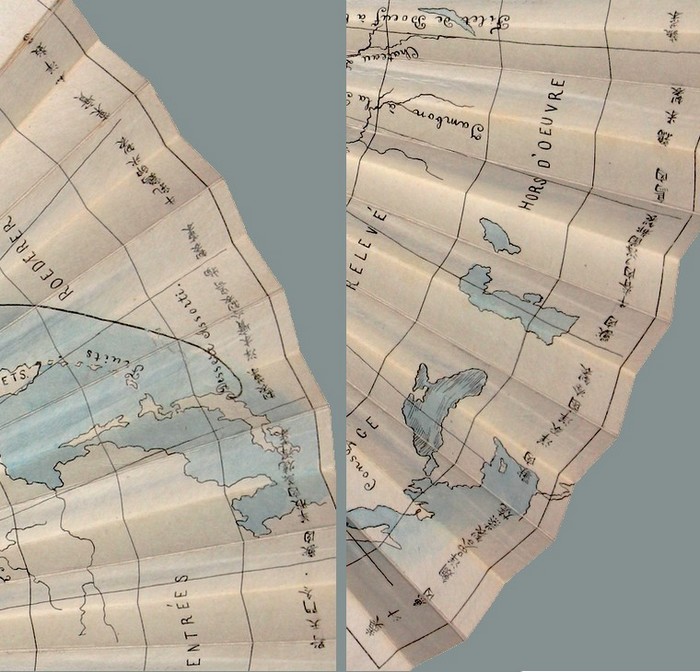
First, we must know what these inscriptions mean. We have shown them to two young Japanese students. They could not read them. It was, literally, Chinese for them! So thank you to any scholar ... (who would be given better photos if needed).
Second, and as often with Japanese fans and some Chinese ones there in a timeless appearance that makes us hesitant in dating the object. Here, it is likely that the fan may well be dated September 15, 1879 ... But was it not rather an artifact made on the occasion of a commemoration of the event?
Third question: What is actually the third flag that we hesitate to identify, and what specific role may have played in the event the nation whose flags are shown?
Last, but not necessarily incidental, we assume that the initial CN on the obverse of the fan are those of the artist. Who is he/she ?
Already some of you have given answers !!!
About the third flag, Anna Checcoli strengthened my opinion, with a link to pictures :
"Vous avez raison, le drapeau est de Suède et Norvège ensemble. Voire ici: http://commons.wikimedia.org/wiki/Category:Historical_flags_of_Norway"
Thanks Anna for answering so quickly !
The second answer came from our son Matthieu...
who was more clever than his father in browsing the WWW. He found this page 191 Vol. II of a book about the Vega
maritime expedition, by Adolf Erik Nordensklöld himself: Nordensklöld (A.E) & Alexander (L.) -trad.-, The Voyage of the Vega round Asia and Europe Echo Library, 2008
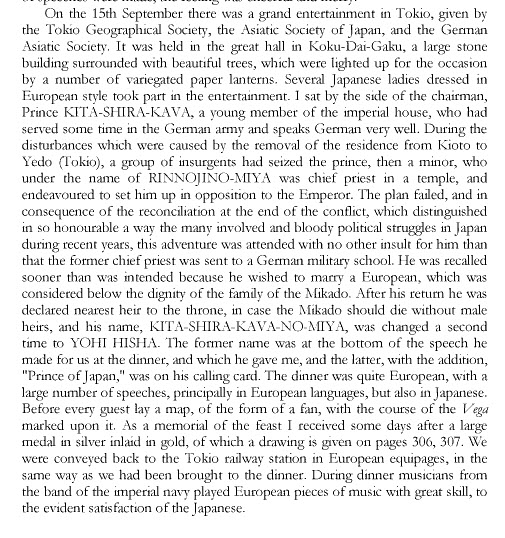
Let us extract the more important sentence (for us) :
The
dinner was quite European, with a large number of speeches, principally
in European languages, but also in Japanese. Before every guest lay a
map, of the form of a fan, with the course of the Vega marked upon it.
So, in a short time, a big part of the questions we asked has been resolved.
But not all of them: our fan could it be a repeat? What about the C.N.initials? About
them, Tom DeLeo, a great connoisseur in food and oriental fans,
spoke of Count Nils. He did it with caution ... and as a mere
suggestion. Will somebody go further?
What is the meaning
of the terms in Japanese or Chinese along the edge of the leaf?
A visit of some Professors of the University of Tokyo to the University
of Rennes helped me to learn that it was the translation of the Menu! Some Japanese students have confirmed the fact. However, I wonder how it was possible to translate those French words that most French people do not know anymore now, like "Relevés"...
So thank you for the moment to Anna, Matthew, Tom, Kotone ... and no doubt, sooner or later to other contributors!
October 2012 Addendum
On the occasion of an excellent symposium organized in Rennes 2 (Territiures du Japonisme),
I took advantage of the presence of Japanese academics, including a
professor from the University of Tokyo, to show them this fan. It
appears that the mentions in Japanese are written with an old spelling,
now difficult to read, but that it is quite simply the translation of the menu. It's a safe bet that the translation into Japanese must be very difficult! Thus, few French people now know what a "relevé" is... (it was a dish served between hors d'oeuvres and starters in the gargantuan meals of yesteryear).
In 2025, I note that a similar fan does exiss, on sale in a specialized bookstore in Boston (Boston Rare Maps) The author of the accurate notice indicates "The fan is mentioned in H. J. Walker, “Nordenskiöld and Science in Japan”. Scientific Bulletin, vol. 5 no. 1 (1980), pp. 26-28. Taiji Yazawa, “A. E. Nordenskiöld and the Tokyo Geographical Society”, Journal of Geography, 1981, vol. 90, no. 2, pp. 51-53".
The first article mentions this range, but without telling us anything.
The second article gives very interesting details on the reception but
we do not find there any information concerning the fan.
I am also aware that a German collector owns another Nordenskiöld
fan: the look is the same but with some differences in the
picture, like the bear head on the recto, which is also printed with
the names of the members of the expedition but not with "Tokio
University". And there is no text in Japanese on the verso giving the
translation of the French menu.
Still questions about this fan!.
Anyways, thank you to my kind interlocutors, and to you, readers who will perhaps add other facts to our knowledge!.
Thank you for your answers to this question and to the other ones ... and for your help in my research !
|