III - THE MASSACRE AND THE FAN
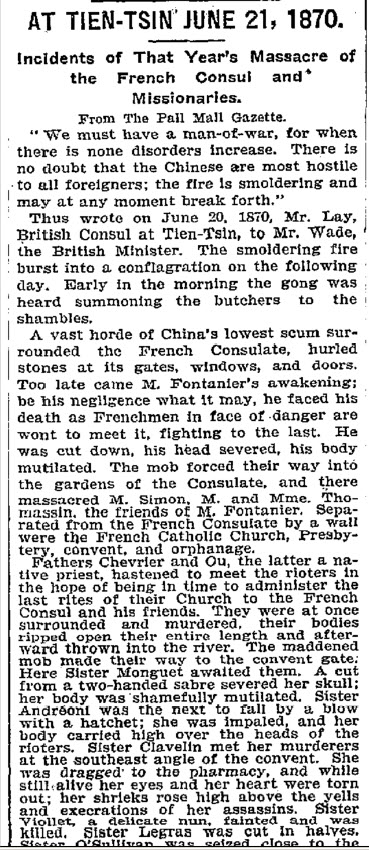
Let us now learn about the tragic events of June 21st 1870. Here is a record of some texts (Word) about them.
And just beneath please find a New York Times article.
But for the sake of brevity, we invite you to click on 3 parts of the fan to obtain 3 close-up pictures with our reading of the events. We give each time another reproduction of the wholefan, but this time from another source ( "The Graphic", November 1870).

The
massacres were immediately condemned by the Chinese authorities. But we
see in their reactions a reluctance (that we understand) as the Celestial
Empire was
more than worried to be occupied by foreigners and to have been the
victim of abuses such as those committed in the Summer Palace 10
years earlier.
"As soon as June 25 appeared an edict of the Emperor, wilting the heinous
act, which directed the Vice-King and the Imperial Commissioner to
conduct an investigation. Nothing is truly done, however, to apprehend the
culprits, and so fifteen days over, they could walk with high foreheads and boast of their shameful deeds that without any shame, they had got painted on fans. "
Our fan is thus an act of political propaganda under the guise of
disseminating information, and was most certainly made to maintain a spirit of
resistance against Western "devils" -mixing neatly, as did the rioters- the
representatives of States and the religious. The fact that the fan represents the murder of the Consul of France just near the door of the Church (clearly designated by the only Chinese characters on the fan) seems to be doing part of a well-concerted "marketing plan" .
This dramatic event, remained long well known in the Catholic
Church but has gone out of the memory of many French because of its occurrence
at the time of the outbreak of the 1870 war with Germany. An so, when Chinese diplomats came to make amends, they bended towards Mr Alphonse Thiers, head of a State which was not yet the Third Republic, regreting the death of a Consul who represented the former Emperor Napoleon III, now exiled.
The
city of Tien-Tsin, however, experienced other Consuls of France: among them, the most
famous diplomat, poet and christian writer Paul Claudel, who must have often
thought to Martyrs of Tien-Tsin when writing his "Cent phrases pour éventails" (Hundred sentences for fans) . One of them will serve as a conclusion !
| "Hush !" |
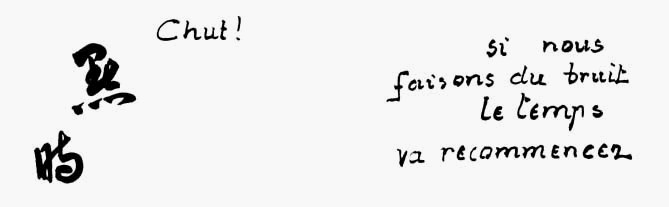 | "If we
make noise,
time
will begin again" |